


Why mindfulness? I could answer this question in one sentence – to prevent life from “slipping through your fingers” and to make it happier… yet, meanwhile:
Oh… again, instead of just checking if someone called, you find yourself scrolling on your phone for 20 minutes,
…and another weekend has passed,
aww, again you have to pay the electricity bill – you just paid the last one, and it’s already the next month,
it’s my birthday again… when did that happen… and so on, and so forth?
Exactly. Without focusing on the present moment, we operate on autopilot and automatic mode — on learned reactions of our body (because the brain doesn’t like to waste energy, so it prefers this way). It takes a really big shock to wake us up from this waking sleep. A fight with a partner, job loss, divorce, death — generally something important and unpleasant — and for a moment we are “here and now”… but we don’t really like it then…
I could basically end here, saying: let’s be mindful — of what is happening right now, and there is a chance — if we want — to notice the good as well (for example, that I have a moment to read something I’m interested in, and time for myself), and life will become nicer…
But our brains don’t work that way — they need proof and arguments that something is worth doing, that it’s good — preferably proven directly by American scientists.
And they need to read or absorb this knowledge many times over to be convinced by the arguments, and changing ourselves and our perception… well, that’s a whole other story.
So, let me expand on the topic (my brain is not unique here).

Arguments in favor (starting with preGrazyna and preJanusz)
Starting from the beginning:
We must go back to the times when our ancestors lived in caves about 40,000 years ago. Yes, our distracted thoughts are a matter of evolution! The problems of proto-Grażyna and proto-Janusz were — you could say — somewhat similar to today’s. They worried just the same: what they would eat the next day, and the next winter, whether they themselves wouldn’t become prey for the saber-toothed tiger (I’ve written about this here before). Proto-Grażyna got upset just as much when proto-Janusz looked at other women, and he worried that if she got angry, there would be no intimacy. They both worried whether their son wouldn’t get into a fight again with the neighbor’s son, etc. etc. Just life.
Meanwhile, evolution didn’t care about their happiness — only survival and keeping the species going. That’s why our brains, instead of being in the present moment, analyze — either the past or worry about the future.
And right now? You are safe — you’re sitting and reading this blog. No saber-toothed tiger will jump out from around the corner.
Maybe this is the solution…?

Why do we need mindfulness?
You can’t invent the future — no matter how much you plan — something might still go differently — not necessarily worse. And you can’t change the past. Moreover — you can draw conclusions from the past to make the future better, you can simply learn from it. And if something unexpected happens in the future — you will be better prepared to deal with it, if only because you won’t be worn out by constant worrying about it.
Of course, I’m not saying that planning or logical thinking are bad. We all know it’s quite the opposite. These traits allowed proto-Grażyna and proto-Janusz to create the cradle of our civilization. They learned how to store food for winter, how to avoid being eaten. They made tools, traded with neighbors, and sometimes even engaged in art, decorating the walls of their homes with paintings. They developed abstract thinking. They learned to live in groups and cultivate plants. But — paradoxically — we do nothing different today.
Try to remember what you just thought about a moment ago? What’s for dinner tomorrow? What time will you be home? Is laundry waiting for you? Tomorrow’s presentation? Bills to pay? A test for the child? I must remember to call back? We worry, planning the future even when it’s not necessary.

The fact of planning itself isn’t the problem — the problem is when these thoughts make us unhappy.
We try to invent how to avoid pain — disappointment, failure, not coping with something — which gives an illusory sense of control over a situation we have no influence on — and so on, in circles.
Thinking about life becomes more important than life itself.
It becomes a habit that is hard to break… We live without noticing that we live and without noticing our actions, bodies, and thoughts in the present moment.
…That is, without focus and mindfulness. And it’s both a tool and a remedy.
More arguments
Have I convinced you yet? Enough arguments?
Of course not! Our behaviors and thoughts are also governed by another primal mechanism serving species survival: our overriding goal — seeking pleasure and avoiding pain.
The reward center in our brain to some extent controls our behavior. We chase pleasures and flee suffering. It’s hard to relax and do something satisfying — there’s always something that could be better, more expensive, more… Here comes comparison, regret over past mistakes, and figuring out how to do things better.
It’s hard to focus on a good movie, your partner’s story about their day, or your child telling the same fairy tale again with enthusiasm.
That’s why we return “here and now” for a moment when a shock happens. Just to go back to “stand-by” mode when the first emotions fade (the brain doesn’t like to waste energy 🙂 ).

Another useful invention of mother nature is that we remember negative experiences more than positive ones (so we can better learn from mistakes).
In this way, we can lose all the beauty of life being in our thoughts about the past or future — never in the present. Our thoughts make us unhappy. Even when we seem content, there are many — if not most — negative thoughts. Example? Going on vacation — our mind quickly fills with thoughts: did we pack everything? Will we have a good room? What if the kids will complain? Will the plane crash…?
We should be resting, but we make a mental list of what could go wrong.
Additionally, we have no contact with our body then — it just is, while we are only in our heads. Daily inattentiveness.
Have you ever arrived somewhere and didn’t remember the way? How did it happen that you didn’t run anyone over on the way?
And now, reading these words, are you aware of your body? Is it comfortable? Warm or cold? Is anything tight? Are you thirsty?

Mindfulness and the hare
Another argument that really resonated with me comes from Ronald D. Siegel’s book “The Mindfulness Solution.” Imagine a hare sitting on a meadow, calmly nibbling grass. Suddenly it notices a fox at the edge of the forest. The hare immediately freezes, its heart races, breathing speeds up, ears listen for sounds, body temperature rises — all these reactions controlled by the autonomic nervous system.
But it turns out the fox didn’t notice or smell the hare and ran back into the forest. After a few moments, the hare’s body returns to normal, calms down, and it resumes eating peacefully.
Now imagine the hare had our brain’s abilities — to analyze and think logically. What might it think? “I wonder where the fox went? Is my family safe? What if it did see me and is coming from the other side? …and a flood of dark thoughts would run through its little head. And here’s the good part: I quote: “If it had truly advanced intellectual abilities, it might even start calculating if it has enough carrots saved for retirement.”
Ha! Indeed! Isn’t that how our thoughts work? One is enough to trigger a cascade of many others (but only negative ones — positive ones aren’t needed for survival!). Consequently: stress, inability to stop intrusive thoughts, panic attacks, and eventually habitual thoughts, depression, and chronic stress… (which we know has very negative effects on our health).
Mindfulness: How do we cope without it? Food for thought
Numerous scientific studies confirm this, e.g.:
- The Whitehall II study (UK) — stress and heart disease, led by Prof. Michael Marmot and team, University College London
- ACEs study – Adverse Childhood Experiences (USA), led by CDC and Kaiser Permanente, Vincent Felitti and Robert Anda
- Studies by Prof. Sheldon Cohen — stress and the immune system, Carnegie Mellon University
But being aware (!) of all these traits and the knowledge about them — we can control them logically and quickly (without over-analyzing). And here we come to the point: mindfulness can help us.

What exactly is mindfulness?
Mindfulness is awareness of the present experience and accepting it — without judgment, noticing what is now.
It’s observing the mind — its thoughts — and signals from the body.
Concentration.
Taking distance — also from oneself. Freedom from pathological worrying.
Being — here and now.
Experiencing and living life with all senses.
Good news at the end — mindfulness can be learned and practiced. And one more thing: you can choose the form and exercise of mindfulness that suits you at the moment.
I chose mine :).
For me, mindfulness is not just sitting in a meditation posture. It’s especially my mindful walks with a camera. Then everything slows down, the senses sharpen, and reality ceases to be the background and becomes the main character. I rest, calm down, relax. I regain strength, I feel happier.
And the topic of mindfulness is so close to me that I will gladly continue it here — also from a theoretical side, because…
The quality of our thoughts directly affects the quality of our lives.
I tested it on myself.

Mindfulness: Does it really work?
Finally, a dose of scientific research on mindfulness confirming its effectiveness and my words above. As if there weren’t enough arguments yet:
- The Laboratory for Affective Neuroscience at Wisconsin — Dr. Richard Davidson and team showed that the brains of people who are often depressed (neurotics, those with anxiety disorders, etc.) show greater activity in the anterior right prefrontal cortex. Conversely, brains of people with less tendency to negative moods show greater activity in its left part — the one that helps build positive feelings, including rewards. The person with the highest left-side activity among the studied was a Buddhist monk with many years of experience in meditation and mindfulness. The study was conducted on stressed employees of a biotech corporation, divided into two groups: one trained 3 hours weekly in mindfulness and meditation techniques, the other not. The meditation group showed significantly higher left prefrontal cortex activity, improved mood, reduced stress, and greater engagement at work.
- Boston State Hospital, Dr. Sara Lazar — MRI comparisons showed that people who meditate regularly have a thicker cerebral cortex. The differences were more pronounced in older adults! The studies also covered the brainstem (where serotonin, the happiness hormone, is produced) and showed that after 8 weeks of regular meditation, neural connections in this area become denser.
- Study by Jon Kabat-Zinn and the MBSR program (Mindfulness-Based Stress Reduction) at the University of Massachusetts Medical School. An 8-week stress reduction training through mindfulness conducted on people suffering from chronic pain and stress disorders. After training, patients reported significant reduction in stress, anxiety, and depressive symptoms; improved quality of life and functioning despite chronic pain; and better emotional regulation. The complete MBSR program is now available online for free — a beautiful way to begin practicing mindfulness in your everyday life.
PS:
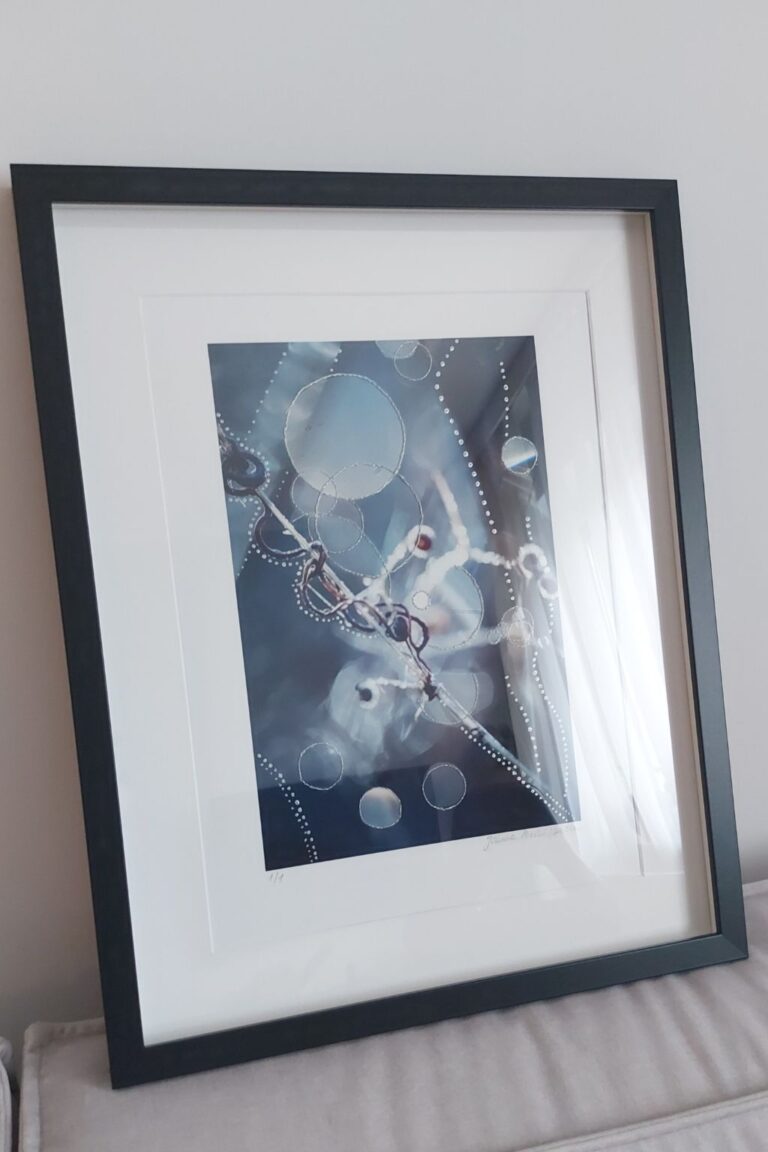
If the idea of a life that doesn’t slip through your fingers resonates with you — a life gently held through my mindful lens — I invite you to explore my collection of photography inspired by nature, mindfulness, and the art of slow living.
These are images created to remind us of the quiet power of pausing.
→ Explore the “Mindfulness” collection
#ThePowerOfAStop #slowlivingart #mindfulart #artofpausing
Have a nice day! See you on next blog post! / Joanna